
 Archive
Local history and history
Horishni Plavni from Ancient Times to the Present: History in Photographs, Objects, and Documents
Publication dedicated to the 60th anniversary of the city
Horishni Plavni from Ancient Times to the Present: History in Photographs, Objects, and Documents / Horishni Plavni City Council of Poltava Region [authors and compilers: M. H. Bezsmolna, K. I. Tkachenko, I. V. Krakalo, and others]. – Horishni Plavni, 2020. – 203 p. ISBN 978-978-2902-13-6.
The book is dedicated to the 60th anniversary of Horishni Plavni and covers the history of the city and the region, starting from the formation of mineral resources in the area and extending to the early 21st century. It consists of six major sections: Paleontological Features, Archaeology of the Region, Chronicle History, Culture and Everyday Life, At the Turn of the Centuries, and The City on the Dnipro.
The section “Paleontological Features” describes the geological structure and relief of the region, which led to the formation of significant iron ore deposits. It also presents one of the theories explaining the origin of numerous findings of fossilized corals, shells, shark teeth, and bones of extinct animals discovered within the territory of the modern city.
The section “Archaeology of the Region” covers the appearance of the first human settlements in the area and their historical development up to the mid-13th century. All information and illustrations are based on archaeological finds from excavation expeditions. The diligent and systematic work of archaeologists, beginning in the first half of the 20th century, is described in detail in the subsection “Archaeological Research of the Region.”
The section “Chronicle History” introduces the reader to the turbulent Cossack era, which significantly influenced the local lands as part of the Poltava region. From the mid-17th century, the area was actively settled by Cossacks. The town of Keleberda, an important center of the Poltava regiment’s sotnia, became prominent, with its Cossackization closely associated with the Zaporozhian Host ataman Ivan Sirko. The narrative also covers the events of the Northern War, the destruction of the Zaporizhian Sich, and the subsequent decline of the Cossack military system.
The section “Culture and Everyday Life” emphasizes the key cultural identifiers of the people—customs, traditions, and language. It describes regional features that shaped the ethnocultural development of the area, including rituals, settlement patterns, housing traditions, crafts, religious practices, and traditional clothing.
The section “At the Turn of the Centuries” reflects a difficult period in the region’s history, including the era of the Great Reforms of Alexander II, mass mobilization during World War I (1914–1918), the establishment of Bolshevik power, the Holodomor of 1932–1933, and the events of World War II (1939–1945), including German occupation and battles along the Dnipro River.
The section “The City on the Dnipro” presents the formation and development of the modern city. Prior to the construction of Horishni Plavni (formerly Komsomolsk until 2016), the iron ore region attracted attention from geologists. One of the discoverers of the magnetic anomaly was the prominent scientist and naturalist Volodymyr Vernadskyi. Construction of the settlement began in 1960 with several dormitories, followed by the development of the mining and processing plant in 1961, which took nearly a decade to complete. Over time, Horishni Plavni grew from an urban-type settlement into a city of regional significance.
The book concludes with an overview of the city’s rapid and ongoing development. Its economy is supported by mining, light, chemical, and food industries, while education, healthcare, sports, and cultural institutions serve the population. High-quality photographs and accessible information illustrate the city’s progress over the past five decades.
“Horishni Plavni: from ancient times to the present” is a kind of chronicle of the native land, serving as a valuable resource for anyone interested in its history.
"“Horishni Plavni: from ancient times to the present” is a kind of chronicle of the native land, covering the path from ancient geological processes and the Cossack era to the development of a modern industrial city on the Dnipro River."
Other materials
Archive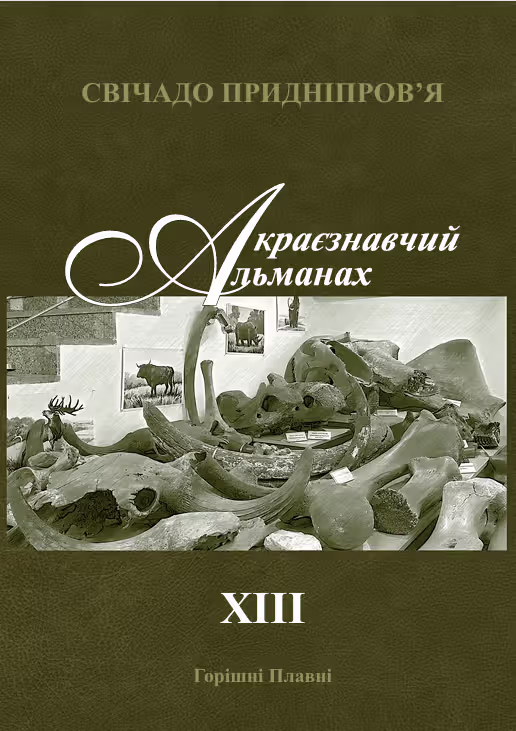 PDF
PDFLOCAL HISTORY AND HISTORY
Svichado Prydniprovia. Local History Almanac. Issue XIII
Collection of Local History and Scholarly Works
 PDF
PDF PDF
PDFLOCAL HISTORY AND HISTORY
Svichado Prydniprovia. Local History Almanac. Issue II
Collection of Local History and Scholarly Works